
Every nation exists twice. Once on the map, and once in the minds of the people who speak about it. The first is defined by geography and borders. The second is shaped by stories. It is those stories, repeated over time, that influence how a country is remembered, admired or misunderstood. They become the lens through which people, both at home and abroad, come to understand its character. Pakistan is no exception.
For decades, much of the conversation about Pakistan has been driven by events. Elections, economic uncertainty, security concerns and political transitions have understandably dominated public discourse. Headlines perform an important public service by documenting these events, but headlines were never meant to define a nation’s identity. They capture moments in time, whereas identity is shaped over generations through the values, relationships and experiences that endure long after the news cycle has moved on. Perhaps one of the greatest mistakes any society can make is to confuse the events taking place within a country with the character of the people who call it home.
Travel across Pakistan and that distinction becomes immediately apparent. The country reveals itself not only through its mountains, rivers, deserts and historic cities, but through countless acts of generosity that rarely attract public attention. It is found in the tea shop owner who refuses payment from a weary traveller, the schoolteacher who continues to educate children despite limited resources, the artisan who preserves centuries-old craftsmanship with quiet pride, and the farmer who greets every season with optimism despite the uncertainties that accompany agriculture. These are not extraordinary people seeking recognition. They are ordinary Pakistanis whose everyday actions quietly shape the country’s identity.
It is often said that a nation’s greatest resource lies beneath its soil or within its economy. Yet history repeatedly reminds us that the most enduring strength of any country is found in its people. Natural resources can be exhausted and economies may rise and fall, but values such as resilience, compassion, hospitality and perseverance continue to define societies across generations. These qualities cannot be measured on an economic dashboard, yet they frequently become the reason people remember a country long after they have left it. Pakistan possesses these qualities in abundance, although they are not always the stories we choose to tell about ourselves.
This is hardly unique to Pakistan. Human beings are naturally drawn to conflict because conflict demands attention. We are more likely to discuss what is broken than what is quietly working. Over time, however, that tendency can distort our perspective. When a nation’s conversation becomes dominated by its challenges alone, its quieter strengths gradually fade from view. Communities that continue to thrive, traditions that continue to unite people, and acts of kindness that strengthen the social fabric all risk becoming invisible simply because they are not considered newsworthy. Yet these quieter stories are often the ones that best explain who we are.
Visit any corner of Pakistan and you will find communities bound together by traditions that have survived for generations. In Gilgit-Baltistan, neighbours still gather to celebrate seasonal harvests. In Sindh, artisans continue to preserve intricate crafts that reflect centuries of cultural heritage. Across Punjab, family recipes, local festivals and village gatherings remain expressions of a shared identity that transcends generations. Along the Makran coast and throughout Khyber Pakhtunkhwa, hospitality is not viewed as an obligation but as a way of life. Each community expresses these values differently, yet together they form a remarkably consistent portrait of Pakistan, one defined less by uniformity than by a shared sense of humanity.
Perhaps this is why the phrase “Dil Se Dekho” carries such significance. It does not simply ask us to look at Pakistan. It asks us to see it differently. Looking is an act of observation. Seeing requires empathy, curiosity and appreciation. It asks us to move beyond the obvious and rediscover the stories that have always existed around us but too often escape our attention.
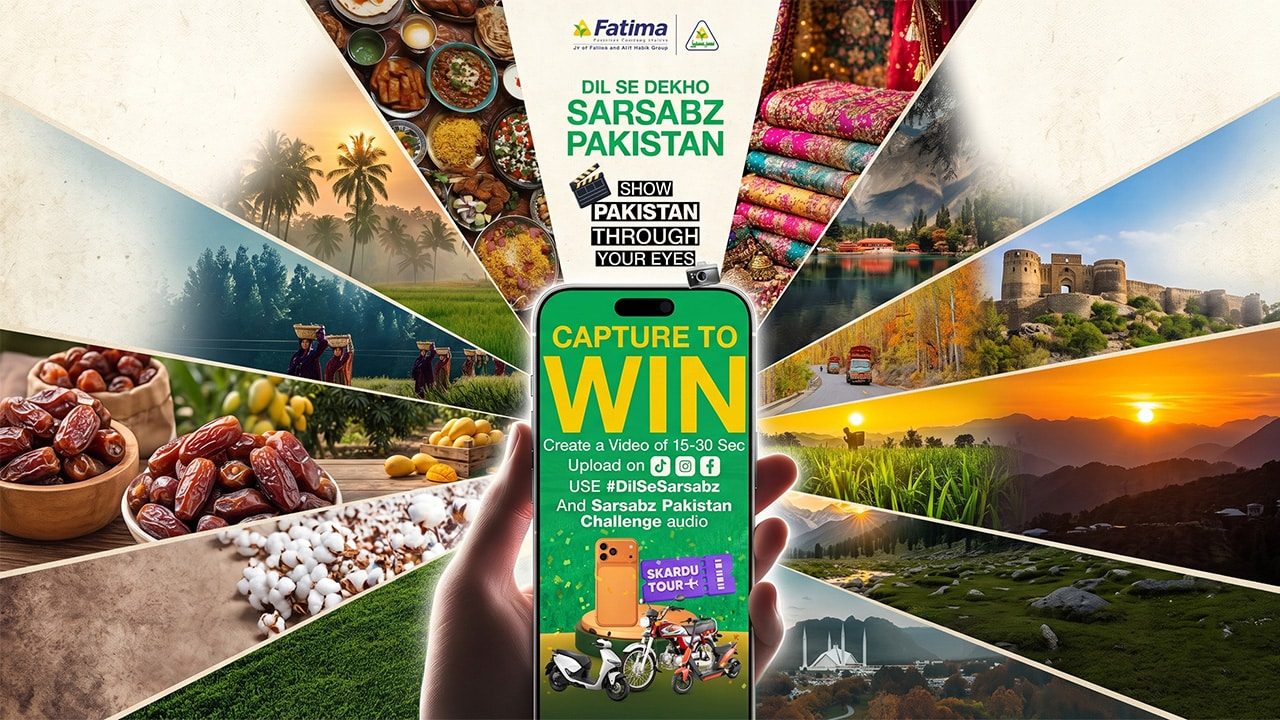
That philosophy lies at the heart of Dil Se Dekho Sarsabz Pakistan, an Independence Day initiative by Sarsabz, the flagship brand of Fatima Fertilizer. Rather than presenting a carefully curated image of Pakistan, the campaign invites Pakistanis themselves to become the storytellers. It reflects the belief that the country’s truest ambassadors are not institutions or advertisements but ordinary citizens who understand the character of their communities better than anyone else. In doing so, the initiative aligns closely with the campaign manifesto’s conviction that Pakistan’s greatest strength lies in its people and that the nation’s diversity becomes most meaningful when viewed through shared experiences rather than differences.
The invitation is intentionally simple. Pakistanis are encouraged to create a short video capturing what makes their hometown unique, whether that is a local tradition, a hidden landmark, regional cuisine, breathtaking natural beauty or the people whose warmth gives the place its identity. By uploading the video publicly on social media using the official Sarsabz Pakistan Challenge audio, including the hashtag #DilSeSarsabz, and tagging the official Sarsabz social media pages, participants contribute to a growing collection of stories that collectively portray a richer, more authentic picture of Pakistan. Alongside the opportunity to win weekly prizes and exciting grand prizes, participants become part of something more enduring: a nationwide celebration of the country’s many identities.
As Pakistan prepares to celebrate another Independence Day, perhaps the most meaningful question is not how loudly we declare our love for the country, but how deeply we understand it. Nations are not strengthened by slogans alone. They are strengthened when their people recognise the dignity in everyday lives, the beauty in familiar places and the values that quietly bind diverse communities together.
After all, the story of Pakistan has never belonged exclusively to its headlines. It has always lived in the countless acts of kindness, resilience and hope that unfold every day across the country. Sometimes, all that is required is the willingness to see them. And perhaps that is what it truly means to see Pakistan with your heart.
The post If Pakistan Was Introduced by its People Rather Than Headlines? appeared first on ProPakistani.