
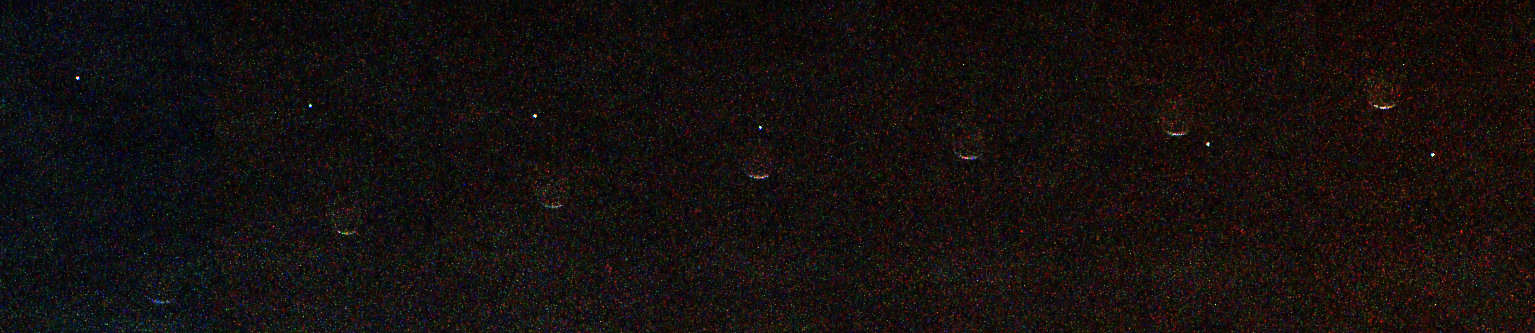

We just played our first game of peekaboo with NASA‘s Perseverance rover as it gazed out at space.
Look closely at this sequence of images. The Mars rover, perched on the rim of Jezero Crater, captured our blue marble rolling behind Phobos, one of Mars’ two moons, on July 2.
Those tiny specks aren’t your keyboard crumbs clinging to the computer screen. They’re actually us and the crescent of a potato-shaped moon. Earth starts as a bright dot in the upper left of the sky, glides diagonally down, and then vanishes as Phobos slides past in the opposite direction.
If you’re not typically impressed by a picture of a single bright pixel, consider this: It’s the first time in human history that we’ve seen Earth disappear behind another world from the surface of another planet.
In the sequence, Earth and Phobos line up in the third frame. Astronomers call this kind of event an occultation — when a larger-appearing object fully blocks something behind it from the observer’s point of view.
That’s technically different from an eclipse because one object completely blocks another from view, instead of simply passing into its shadow or covering it in a way that looks like an eclipse. When a smaller-appearing object crosses the face of a larger one without concealing it completely, astronomers call that a transit, though sometimes when Phobos or Mars’ other moon, Deimos, crosses in front of the sun, they’re informally called solar eclipses.


Credit: NASA / JPL-Caltech / ASU / MSSS / SSI
Mark Lemmon, a co-investigator of the rover’s Mastcam-Z instrument, planned the historic observation and assembled the composite. The entire sequence unfolded over a period of 40 seconds, according to NASA’s image annotations.
“Phobos crosses the Martian sky three times a day, and Earth is visible for months at a stretch,” said Lemmon, based at the Space Science Institute in Boulder, Colorado, in a statement, “but catching one directly behind the other takes planning and a little luck.”
Despite being about 17 miles wide, Phobos is visible from the Martian surface. The lumpy-bumpy moon orbits just 4,850 miles from the Red Planet, so to Perseverance, Phobos looks pretty darn big — about one-third the apparent width of our much larger moon looming in the sky above Earth.
From the rover’s vantage point, Earth is nothing more than a glint of light. When the images were taken, our planet sat about 195 million miles away.
And just like that, our cosmic ships passed in the night.